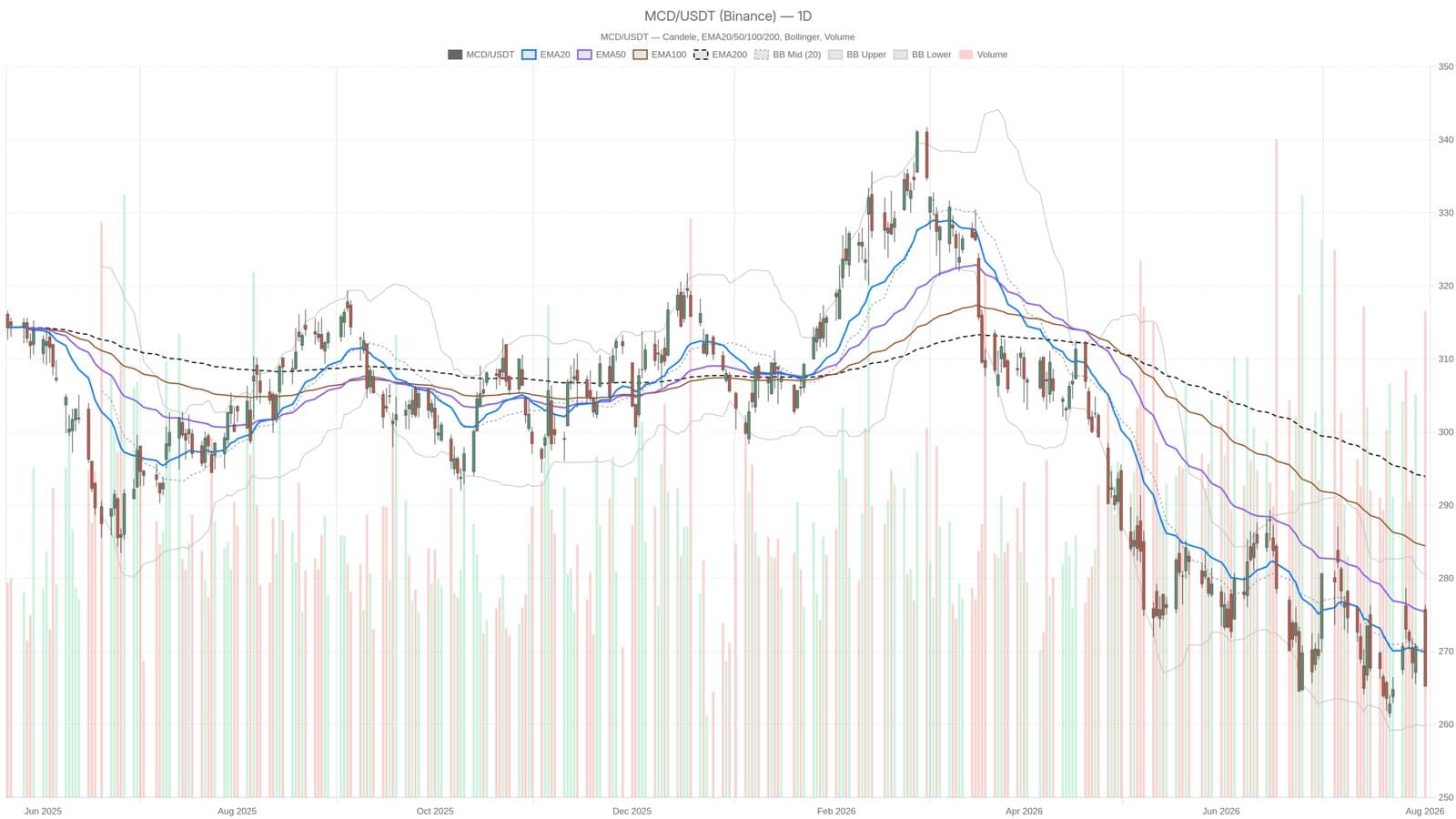
McDonald's shares collapsed past $265 on August 3, gapping straight to the session low. The plunge wiped $191 billion off the market cap. What triggered it was deceptively simple: same-store sales slowed across America, fewer customers walked in, and beef kept getting more expensive. Yet the technical damage run much deeper than the headlines suggested.
The stock has now lost 11 percent since January 2026. Every moving average is stacked against the bulls. On the daily chart, the 20-day EMA sits at $269.85, the 50-day at $275.39, and the 200-day all the way up at $293.94. That nearly 29-point gap to the 200-day line tells the whole story, price having drifted so far from its long-term footing that a rebound would require conviction nobody is showing right now.
Momentum Still Has Room to Fall
The RSI on the daily timeframe reads 43.08, which is weak but nowhere near the 30 threshold where oversold conditions typically trigger a bounce. Traders call this the dangerous zone, the point where weakness can still extend without the technical exhaustion that usually marks a bottom. The MACD histogram sits at minus 0.44 on the hourly, widening to the downside. That's accelerating bearish momentum, not stabilizing.
What catches attention is a small tick upward in the histogram from the prior reading, but it's a feint rather than a reversal signal. The selloff is just catching its breath between waves. Most likely scenario from here is another test of the first support level at $261.53. If that breaks, the lower Bollinger Band near $259.76 comes into play, opening a clean path lower.
The Real Problem Under the Hood
Technical charts show structure, but earnings misses show hunger. American consumers are eating out less frequently, traffic metrics turned negative, and commodity costs aren't heading south anytime soon. For a company built on reliability and volume, slowing foot traffic is the kind of wound that doesn't heal with one good quarter. Franchise operators tightened guidance, which means the pain will echo through summer and into fall.
The gap down on August 3 wasn't panic noise. It was institutional money taking the exit when the bell rang. Until same-store sales stabilize and traffic trends reverse, any bounce will face sellers waiting at lower moving averages.
This material is informational analysis of market technicals and earnings data. It is not financial advice and should not be treated as a recommendation to buy, sell, or hold any security.