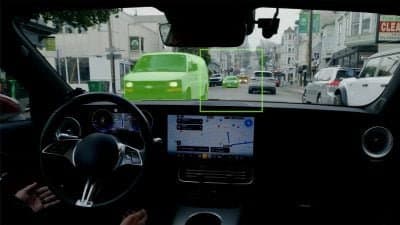
Nvidia just handed over Alpamayo 2 Super, a 34 billion parameter reasoning model built specifically for autonomous vehicles. The catch: it's now free to use, modify and deploy commercially. On Tuesday the chip giant released it through Hugging Face under an open license, meaning automakers and robotaxi startups can fine-tune it on their own fleet data and ship it in production.
The model triple-sizes Nvidia's previous generation. Alpamayo 1 and 1.5 ran on 10 billion parameters each. This one packs 32 billion into its reasoning backbone plus another 2.3 billion for the action prediction layer. It trained on 115,000 hours of multi-camera driving footage and learned to reason through 3.7 million real driving decisions.
What it actually does behind the wheel
Feed Alpamayo 2 Super video from all four sides of a car front, rear, left, right plus your destination and recent movement history. It spits back three things: a planned trajectory for the next 6.4 seconds, a chain of reasoning explaining why it chose that path, and high-level commands like yield, merge or stop. That reasoning trace is the whole trick. It's not just steering. The model explains the causation. Intersection ahead with cross traffic. Three pedestrians on the left curb. Red light. Therefore: brake.
Developers can also extract visual answers from camera feeds, tie those answers to specific regions in the image, and use the model to auto-label raw driving clips for training. Convert a terabyte of fleet video into labeled, machine-readable data. That's the play for companies sitting on proprietary footage but lacking the infrastructure to turn it into training material.
Why the timing matters
Alpamayo 2 Super ranked first among nearly 40 competing models on LingoQA, a benchmark designed for autonomous driving reasoning tasks. Nvidia used their own Lingo Judge metric to measure performance. But the real signal here isn't the benchmark win. It's the license. The OpenMDW 1.1 framework allows derivative works and commercial redistribution. Nvidia is also retroactively opening earlier Alpamayo models under the same terms, converting what started as research-only code into infrastructure anyone can build on.
Self-driving is expensive. Data labeling is brutal. Nvidia just handed companies a tool to make both cheaper. Whether that accelerates robotaxis to scale or floods the market with half-baked autonomous systems depends entirely on who gets access and how careful they are with deployment.
This article is informational only and does not constitute investment or technical advice.