Forty-eight hours at Black Hat USA 2026 changed something fundamental about how the industry sees AI risk. Over two days, more than 15 vendors dropped specialized tools for securing autonomous agents and Model Context Protocol servers. This wasn't scattered announcements scattered across a conference. This was coordinated. The market had suddenly crystallized.
The briefings on Day 1 showed how fragile agent systems really are. Researchers demonstrated vulnerabilities at the framework level, compute-layer attacks that could hijack entire agentic workflows. The vendor community watched, took notes, and by the next morning, product teams had launched solutions. The abstract debate about AI safety moved sideways. What mattered now was keeping autonomous systems from breaking in production.
Visibility comes first
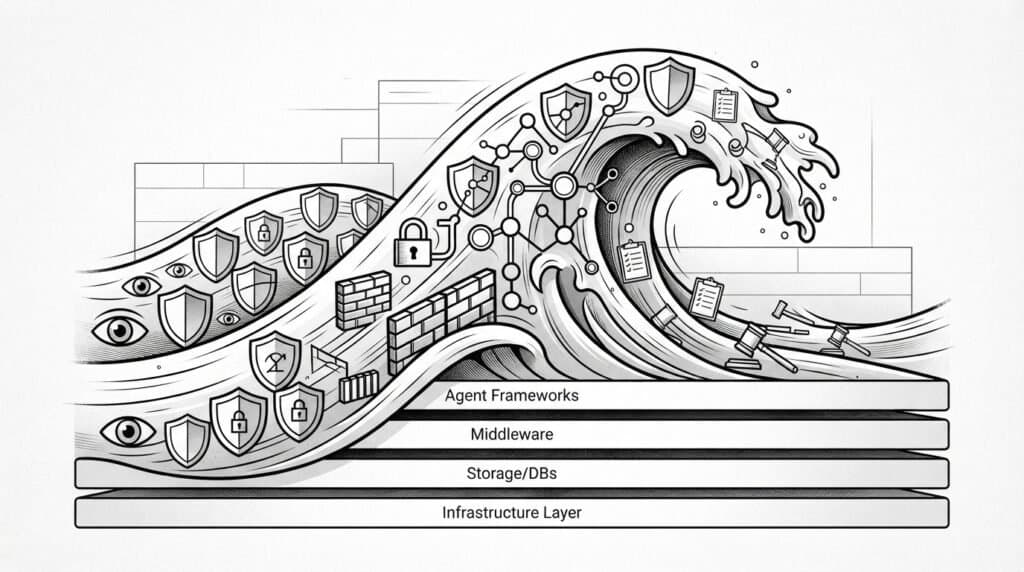
Every security team asking the same question: where are our agents running? Agents and MCP servers operate silently across enterprise networks, often invisible until something goes wrong. Cyera shipped Agent Guardian to hunt shadow agents hiding in endpoints, SaaS platforms, and cloud environments. Rubrik added Agent Identity for inventory and access control, plus Agent Rewind to roll back damage. SailPoint's approach uses browser and endpoint sensors to expose hidden agents directly.
The pattern here is obvious. Before you defend something, you need to know it exists.
Then you lock it down
Once visibility is live, the focus shifts to runtime intervention. Check Point's AI Network Firewall intercepts MCP communications in real time. Sweet Security blocks unauthorized tool calls before they execute. Zero Networks goes further, enforcing least-agency principles and forcing human approval for sensitive operations.
These aren't monitoring tools. They're active defense. They stop bad calls mid-execution.
MCP itself became the target
The Model Context Protocol emerged as the primary attack surface. Tanium released Atlas MCP Server to expose data safely to Claude and Security Copilot. Promptfoo built an MCP Proxy for encrypted communications, demonstrating live red-team scenarios at OpenAI's booth. Legit Security introduced VibeGuard 2.0 specifically for AI coding agents with MCP-level controls.
The convergence is striking. Fifteen vendors, four functional buckets, and a sudden market agreement on what autonomous agent security actually means.
This article covers industry announcements and market trends. Not investment advice, and not a technical endorsement of any platform mentioned.