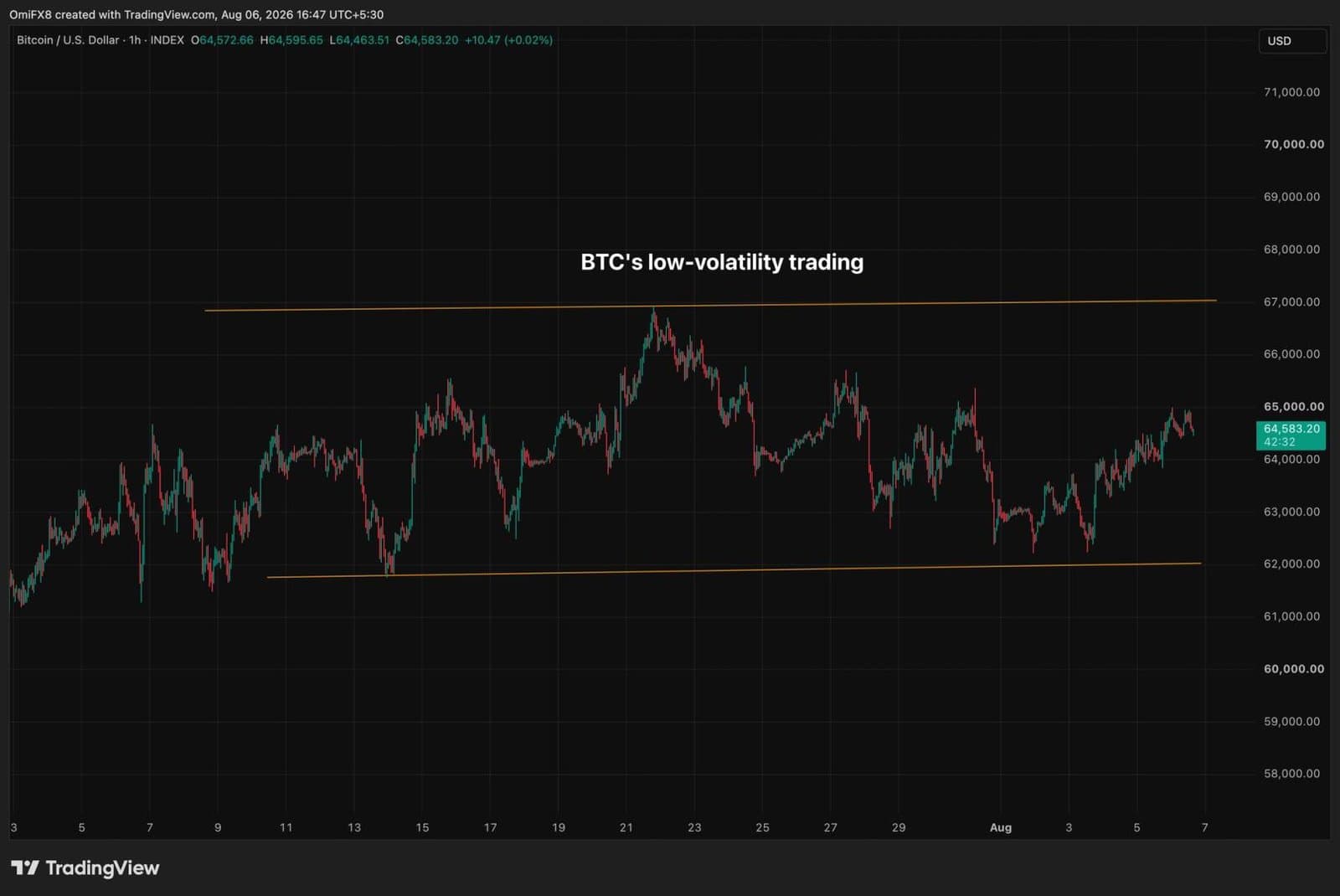
Bitcoin hovers below $65,000, looking remarkably steady. The 30-day implied volatility has hit 36%, a level the market knows well. On the surface, this calm feels safe. Price swings are tiny compared to the wild gyrations of stock indices like South Korea's Kospi. But the steadiness hides a trap.
Low volatility doesn't mean low risk. It means something far more dangerous: cheap trading. When option premiums collapse, speculators load up on directional bets at bargain prices. Market makers absorb the other side of those trades, stacking up massive exposure themselves. Everyone feels confident because nothing's moving. Then one number changes, one level breaks, and suddenly both sides are scrambling to unwind.
When calm breaks, it breaks fast
Adam Haeems, head of asset management at Tesseract Group which runs $500 million in client money, spells it out plainly. "When volatility is cheap, traders can build directional positions and hedges at relatively low cost. If the market then moves through a level with concentrated positioning, dealer hedging can accelerate the move." The practical consequence: use becomes a liability. Trading volumes have thinned. Market depth is weak. That's exactly when a sharp move turns into a cascade.
Volatility doesn't stay suppressed forever. It reverts. History shows this pattern repeating, which is why traders call it mean reversion. The cheaper it gets, the faster it tends to snap back. Paul Howard, senior director at market-making firm Wincent, reads the options flow differently though. Put demand has dried up, meaning fewer traders are hedging downside. Strong bids for upside exposure are also missing. His interpretation: the bear market bottom might be forming over the coming weeks. But that read assumes the current positioning holds. It won't.
This article is informational only and should not be construed as financial advice. Always conduct your own research before trading or investing in cryptocurrencies.