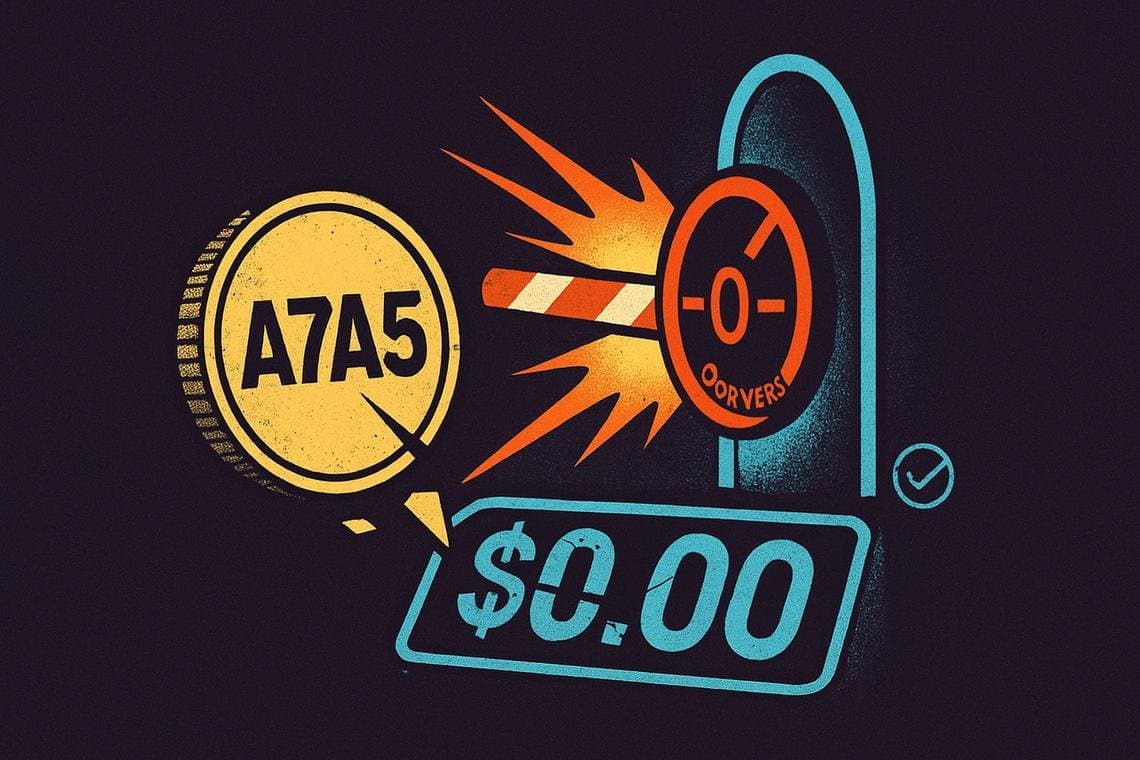
The A7A5 stablecoin has collapsed from a bustling asset powering over $100 billion in transactions to trading at zero, wiped out almost entirely in a single blow from international sanctions. The token lost 96% of its value after the U.S., EU, and U.K. blocked all conversion paths, leaving holders with no exit.
Tied directly to a sanctioned Russian state bank, A7A5 operated on the A7 network, which Chainalysis flagged as a purpose-built scheme to bypass sanctions. The network moved nearly $120 billion across borders, exploiting crypto’s anonymity to shield Russian financial flows. This caught the eye of global regulators.
Sanctions sweep targets crypto and shadow networks
The European Union’s 21st sanctions package hit the A7 network hard, alongside over a hundred banks and crypto operators, shadow fleet vessels, and oil refineries linked to Russia and Belarus. The crackdown also targeted A7’s expansion into Africa. EU High Representative Kaja Kallas emphasized the broad scale of measures to cut off Russia’s financial lifelines.
Since the sanctions, A7A5’s smart contracts technically function, yet all conversion mechanisms are frozen. Mainstream exchanges have started screening deposits from the A7 network rigorously, halting liquidity and draining the token’s market. This sharp disruption shows how geopolitical actions can abruptly dismantle a crypto asset’s ecosystem.
This is an informational update, not financial advice.